Sthala Purana & Heritage
Temple History
Centuries of Divine Grace, Royal Patronage, Miraculous Consecrations, and Sacred Traditions at Shri Venkataramana Temple, Mulki.
Sthala Purana & Origin
The Legend of Volalanke & Moolikapura
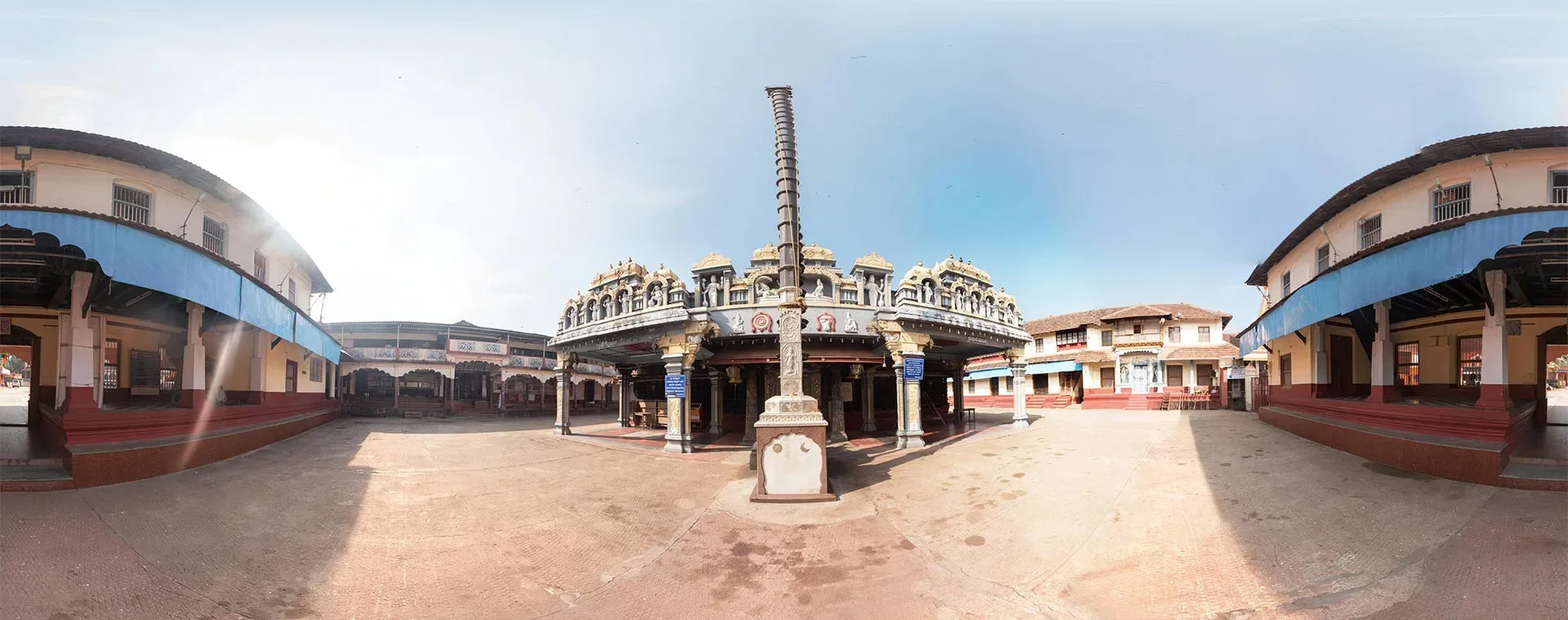
Mulki happened to be the capital of a small kingdom of Jain rulers called the Savanths. Standing gracefully on the banks of river Shambhavi, close to the Arabian Sea, the town boasts one of the most prominent temples of the Gowda Saraswat Brahmin (GSB) community.
On the eastern part of Mulki, facing East, stands our Shri Venkataramana Temple located in an area known as Vola-Lanke, which literally translates to "Inner Lanka".
The presiding Lord of this temple, Lord Ugra Narasimha, is popularly revered as Volalanke Ugra Narasimha or Volalankadisha.
Why is this place called Volalanke?
The Sthala Purana reveals that Lord Hanuman, on his way back carrying the mountain of life-saving herbs (Sanjeevani Parvatha), mistook this beautiful locality for Lanka and started descending.
Soon realizing that this was not Lanka, he immediately ascended back into the skies and resumed his journey, calling this sacred place Volalanke.
13th Century Foundation
The Consecration of Vittala Gudi
The temple was originally consecrated as “Vittala Gudi”. On an invitation from the Jain Savanth rulers, five GSB families from Bhatkal came and settled in Mulki.
The sacred idol of Lord Vittala belonging to the Vatsa Gotra family was installed in a small sanctuary and affectionately named the Vittala Gudi.
This divine installation is believed to have taken place sometime in the 13th century. Later, more families migrated to Mulki and made it their eternal home.
13th Century Era
The original root sanctuary of Shri Venkataramana Temple Mulki, established by the Vatsa Gotra family under Jain Savanth royal invitation.
Early 16th Century Miracle
Lord Venkataramana from Padu Tirupathi
Sometime in the early 16th century (about 500 years ago), due to political upheavals in Karkala (famously known as Padu Tirupati), there arose a grave threat to the Shri Venkataramana Temple of Karkala.
The Sacred Well
To protect their beloved Lord Venkataramana's idol, the devotees of Karkala secretly carried the idols to Mulki and hid them inside a deep well at Vittala Gudi.
The Divine Sign
When normalcy returned, Karkala devotees searched the well but could not find the idols. However, when Mulki devotees searched, the idols appeared immediately!
Dream Revelation
The Lord appeared in a dream to Karkala devotees, assuring them that a Sanyasi would grant them a new idol in Karkala within days.
Consecration by Srimad Vijayeendra Thirtha Swamiji
Lord Ugra Narasimha
Lord Ugra Narasimha was consecrated in Mulki on the auspicious day of Margashira Poornima by Srimad Vijayeendra Thirtha Swamiji.
Swamiji found this beautiful, awe-inspiring idol of Ugra Narasimha in Kerala. Sacred traditions record that the idol was either discovered in a well alongside Lord Venkatachalapathy of Cochin TTD, or worshipped at Varahapuram near Cochin. Srimad Vijayeendra Thirtha Swamiji also initiated Shri Yadavendra Thirtha Swamiji—the first pontiff of Shree Kashi Mutt Samsthan.
8 Unique Features of Mulki Ugra Narasimha
8-Armed Form
Adorned with eight divine arms of celestial power.
3-Eyed Posture
Possessing three cosmic eyes of supreme vision.
Standing on One Leg
Heroic, singular stance of divine stability.
Ferocious Posture
Depicted slaying Hiranyakashipu without Lakshmi or Prahlada.
Victorious Garland
Holding the intestines of the demon king as a garland.
Chest Mark
Bearing the sacred mark of Bhrigu on His divine chest.
Navel Lotus
Exquisitely carved lotus emerging from His navel.
Chakra Impression
Sandalwood Chakra impression given as protective lockets.
The Utsava Murti from Varanasi
Lord Bindu Madhav & Kashi Mutt Heritage
Lord Bindu Madhav is the sacred Utsava Murti of Shri Venkataramana Temple Mulki. This divine idol was discovered in the holy Ganga at Varanasi by Shri Madhavendra Thirtha Swamiji while bathing at the ghats.
Lord Bindu Madhav is one of the principal deities of Varanasi. During the period of Shri Madhavendra Thirtha Swamiji, the main idol of Kashi Lord Bindu Madhav was transferred to the Moola Mutt of Kashi Mutt for protection from invaders, and this idol was worshipped alongside it.
Brahma Rathotsava & Pariyaya System
Shri Madhavendra Thirtha Swamiji lovingly consecrated Lord Bindu Madhav at Mulki, establishing Him to partake in all Utsavs. Swamiji initiated the grand Brahma Rathotsava on Ram Navami and brought the Atri Gotra family of priests from Cochin to establish the rotating Pariyaya System between Vatsa Gotra and Atri Gotra families.
The Oracle of Shri Kal Bhairav
It was during the divine era of Shri Madhavendra Thirtha Swamiji that the famous Kal Bhairav Oracle (Prashna / Darshan) was instituted in the temple. Along with Lord Bindu Madhav came the Brahma Rathotsava, and with the Rathotsava came the Kal Bhairav Oracle, blessing generations of devotees.
Explore Sacred Sanctums
Experience the Living Heritage of Mulki
Discover the presiding deities on the sacred Simhasana, the 4 Parivara Deities, and the sacred shrines of Naga Katte & Daiva Gudis.